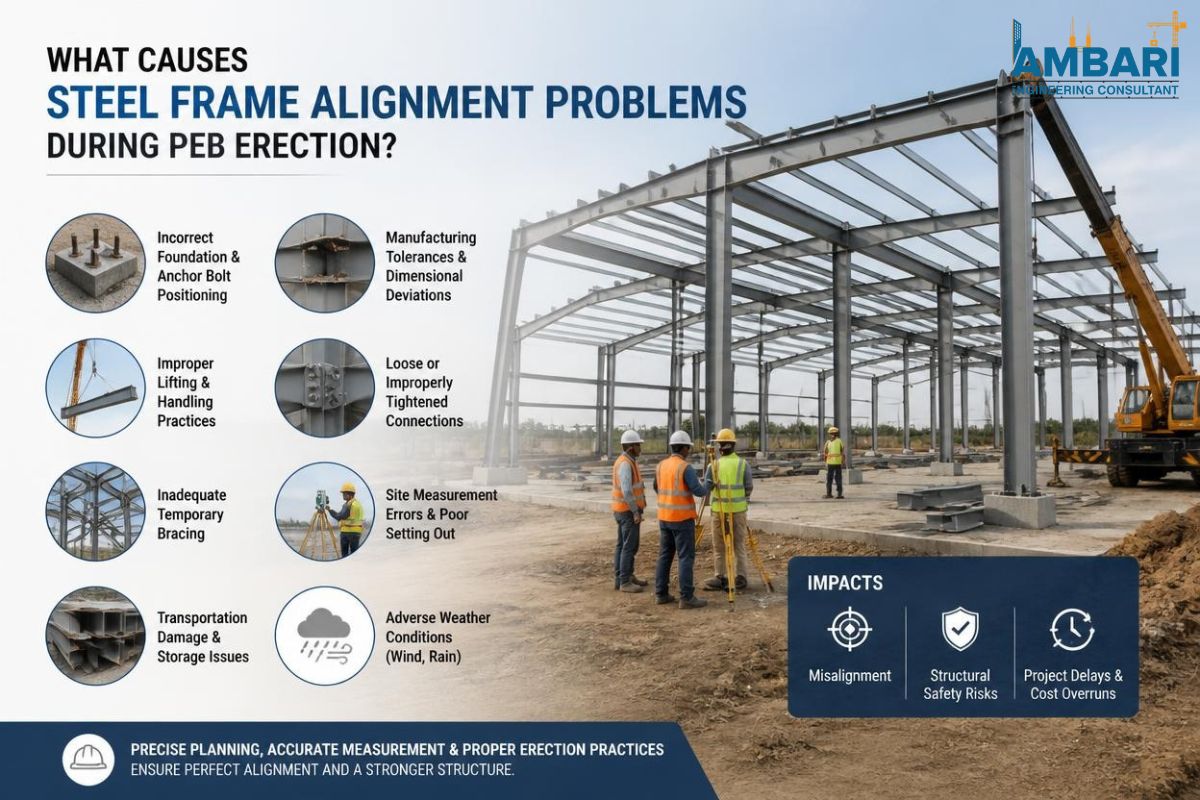
.png)

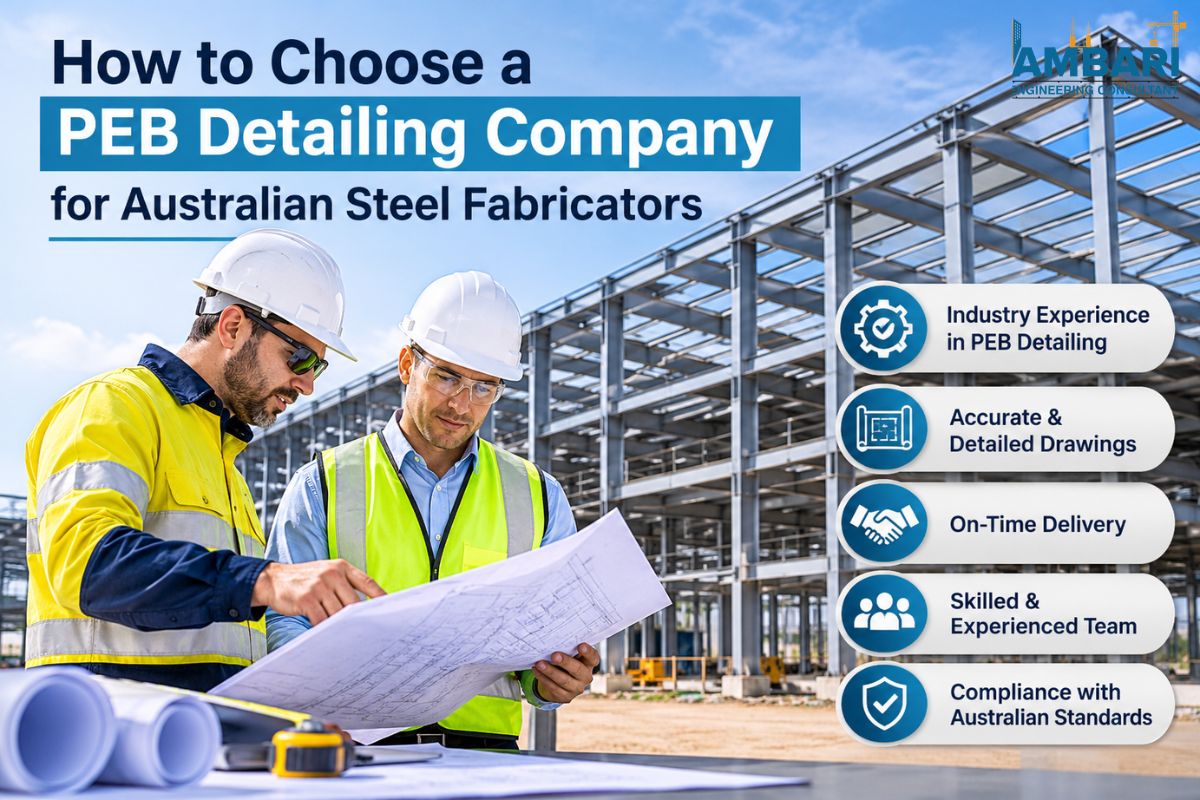
Table of Contents
In order to select a PEB detailing firm for your Australian fabrication needs, there are four essential criteria to consider. Firstly, look for extensive experience in pre-engineered buildings. Secondly, ensure that the company understands Australian standards like AS 4100 or AS/NZS 5131. Thirdly, investigate their quality assurance practices. Fourthly, check their speed of delivery of key documents in a timely fashion.
A good PEB detailing partner has the ability to turn your engineering designs into exact, workable blueprints. Lastly, it is important to find out about their communication skills between their engineering staff and the client, their attitudes towards revisions, as well as their pricing practices. This guide will break down each important consideration in such a way that will help you fully appreciate PEB detailing services throughout Australia.
Pre-Engineered Buildings (PEBs) are buildings made from steel where the engineering process is carried out by the engineering team of the manufacturer and then assembled in parts. This uses standardized connections, member sizes, and loading assumptions, making the process quicker and less expensive than fully customized steel buildings. The Detailing process is the link between the engineering design process and the fabrication process on the shop floor. It converts the design intent into drawings that a fabricator can cut, drill, weld, and assemble without any guesswork.
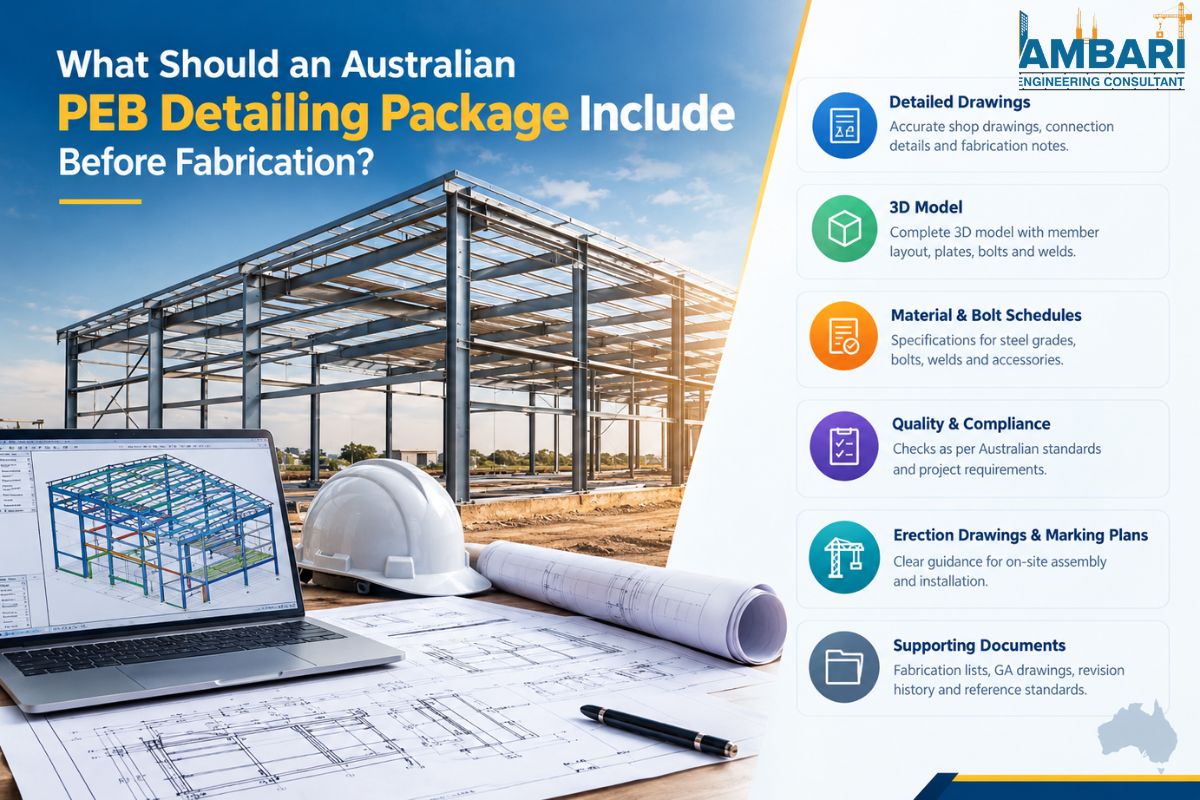
The first step in a typical detailing package is the design calculations and layout drawings provided by the engineer of record. Then the detailer will create general arrangement drawings, member lists, connection drawings, shop drawings, and erection drawings. All the drawings should be identical. The base plate of a column drawn in one sheet should have the same anchor bolt pattern in the foundation drawing and follow the erection sequence.
General steel detailing covers a wide range of structures, from bridges to warehouses to multi-storey frames. PEB detailing is more concerned with a more limited class of connections and members that are repeated across a building. This specialization translates into a good PEB detailer knowing the manufacturer’s logic, knowing where the errors lie, and being able to work quickly within a standard framework. May be able to perform a general detailer but may need additional supervision and time to complete PEB-specific tasks.
In Australia, numerous manufacturers are engaged in high-volume production and don't maintain a large in-house detailing staff. Attracting staff that fit the bill in both software knowledge and steel expertise is tough, and their workload can fluctuate in line with the ebb and flow of project pipelines. Outsourcing allows a fabricator to increase its order volume or frequency without incurring any fixed overhead. It also provides access to experts who have already resolved common issues that are encountered in PEB projects.
There are three common signs of capacity pressure. The first one is a rush of tenders, which need to be priced and delivered in a short time frame. The second one is a project that has a short fabrication time, and the detailing needs to be completed as quickly as possible so as to order and cut materials. The third is during holidays when the master detailers are occupied with other jobs. The detailing partner overcomes these limitations by being able to increase capacity without impacting the fabricator's shop schedule.
Steel fabrication margins are tight, and mistakes are costly. An inaccurate hole position can cause a halt to a shop floor crew, a remake of a member, and a delay of a site erection. The risks can be minimized if the work is outsourced to a competent provider, as the detailer’s job is to ensure that a clash and consistency check is performed before fabrication begins. Detailing fees should not be viewed as a cost line, but as one of the items that a fabricator should consider as a quality protection.
While some businesses may advertise as steel detailers, they may not provide all the services a fabrication company requires. Before narrowing down the providers, jot down the outputs your shop needs. An open scope helps avoid unpleasant surprises like finding after a project has started that cutting lists are not available or that erection drawings have to be bought separately.
The table below shows the core services to look for and why each one matters to a fabricator.
| Service | What It Covers | Why It Matters to Fabricators |
|---|---|---|
| Shop drawings | Member and connection fabrication details | Direct input for cutting, drilling, and welding |
| Erection drawings | Assembly sequence and site positioning | Helps the erection crew work safely and efficiently |
| Cutting and bill of materials | Member lengths, quantities, and material grades | Supports purchasing and reduces material waste |
| Connection design support | Detailing of bolted and welded joints | Ensures joints match the engineering intent |
| Revision management | Updates after design or client changes | Keeps all drawings consistent across versions |
Many fabricators also want PEB fabrication drawing services in Australia that offer native file outputs, which allow cutting and nesting teams to import into the data directly. Ask if the provider can provide machine-readable data files and printable PDF sheets. This feature can save valuable time in an automated shop with cutting or punching.
The most critical aspect of selecting a detailing partner is the skill they have. Your team will have to pay if a company has attractive marketing, but their drawings contain errors, even if the company has low prices. Assessment should not be limited to checking a company's ability to perform PEB work. Ask a question about how it does PEB, what it checks first, and what to do when it has a problem.
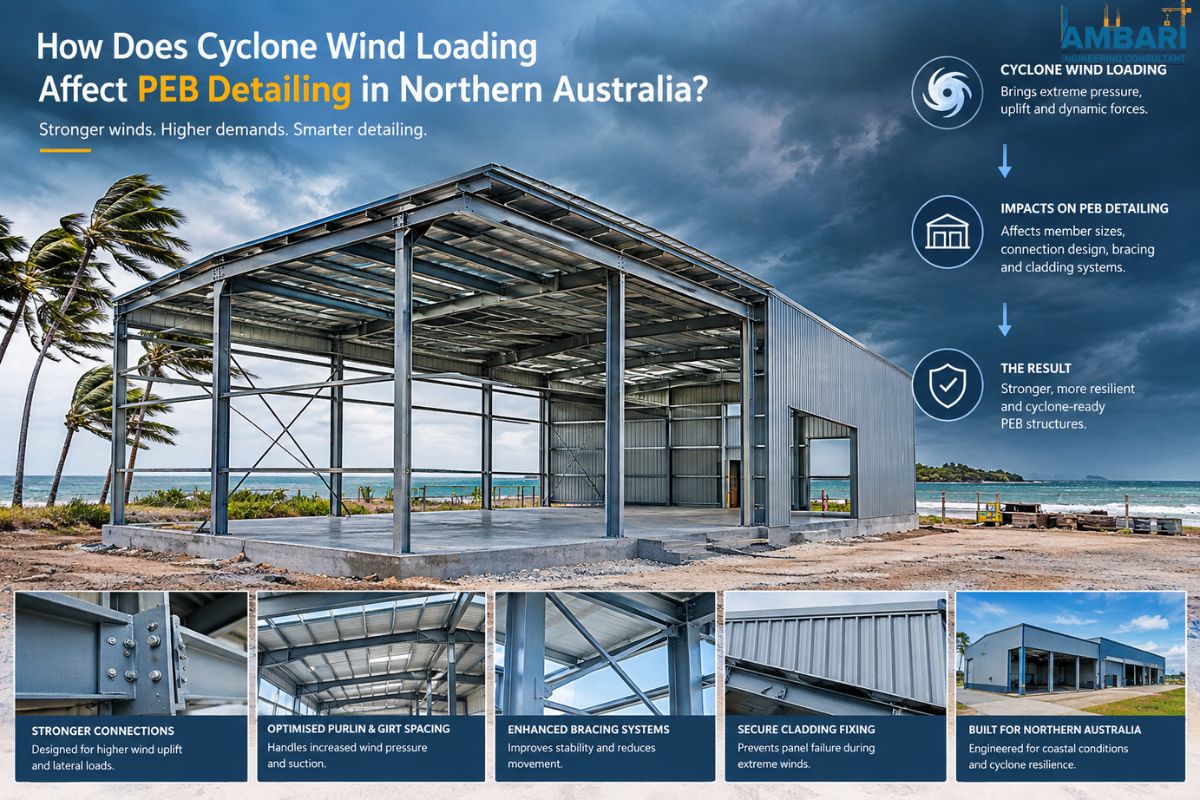
Search for years of experience, not just steel detailing. Inquire if the team has finished any PEB projects in the last 2 years, the size of buildings they have worked with, and if they have completed projects in similar climates or wind and seismic zones. Australian projects frequently require regional wind classifications, cyclone wind protection requirements in certain regions, and particular cladding & fixing requirements. A detailer who is knowledgeable about these situations will have better questions to ask at the beginning of a job.
Today's detailing is three-dimensional, and the team can identify clashes between members, connections, and services, like ducts and cable trays. Inquire about how it creates and tests models and whether it performs clash checking before drawing issuance. This is a sign of a well-organised detailer who can clearly explain the process of modelling and checking the process. Someone who is giving fuzzy answers might be engaged in hand-coding, which takes more time and is prone to more mistakes.
Steel Detailing in Australia should abide by the design and fabrication codes of Australia. Your detailing partner should be familiar with these standards and should be able to perform them independently without the need for a supervisor's guidance. AS 4100 is for steel structures, AS/NZS 5131 is for the fabrication and erection of structural steel, AS 1554 series is for welding of structural steel, and AS/NZS 1170 series is for structural design actions including wind and live loads. Standards will be revised periodically; inquire with the provider how it stays current with the most recent version of the standards and how it verifies which version applies to the project.
Your detailer should also be familiar with how the detailing of the structural steel detailing services Australia is expected to meet the needs of the engineer of record and the principal contractor. However, having a set of standards does not guarantee good drawings, but a provider who holds that standards are the basis of their confident work and can tell you how they impact on connection design will be more likely to create drawings that are compliant. Have them demonstrate the standards they used on a recent project they have been involved in.
The most direct proof of a company's ability is a portfolio. But a shiny portfolio can be deceiving when the projects offered are not similar to yours. Target a company if the finished product is similar to your building types, member sizes, connectors, and delivery time. A company that has detailed hundreds of warehouse frames may be the perfect company to consider for a warehouse project, but not a building with complex mezzanines and heavy crane loads.
A useful portfolio will have representative drawings and not just photographs or renders. Request samples of shop drawings, connection plans, bill of materials, and erection drawings. Examine the labelling of the drawings, completion of notes, and consistency of dimensions. When someone has a good drawing, it doesn't have to be read constantly in the office, to be read by the fabrication team.
Request references from past fabricator clients, and get to know past clients if possible. Question for accuracy, responsiveness and how the detailer made changes. You can also request the provider to take you through one project that they have already finished from start to finish. Notice the way in which they state problems. Businesses that acknowledge their problems and detail how they managed to overcome them are likely to have better internal systems than companies that say their work is always flawless.
Quality control is the dividing line between a reliable and an exorbitantly more expensive detailing service. Drawings should go through several stages of review before they get to your shop. These tend to be the detailer's self-check, an independent check by another person, and a final check against the engineering design. Document each stage so that you can see who checked it and when.
A good detailing process typically begins with a checklist that includes dimensions, material grades, bolt sizes, weld symbols, and notes. This drawing is then reviewed by a second detailer, who is not the original artist. Finally, a sample of drawings is checked by a senior reviewer based on the design calculations and the client's requirements.
However, the provider can also conduct a clash detection review of the three-dimensional model for larger projects. If these checks are documented, inquire whether they are documented in a quality log and whether you can view that log if necessary.
Changes are part and parcel of steel projects. These may need to be updated due to design changes, client requests, or site conditions. The important question is ‘how is the provider controlling them’. Every revised drawing should be numbered, annotated with a description of the change, and dated. The provider should also let you know which drawings are being affected, and your shop will not cut material from an old sheet. Inquire: How are old versions archived, and how are superseded drawings taken out of circulation?
No matter how accurate they are, drawings that are late are useless. Any turnaround time should be from the date all required information is received, not from the date an enquiry is made. Inquire of the service provider about their turnaround for all deliverables, including shop drawings, erection drawings, and the bill of materials. Additionally, inquire what information it requires to get started and how quickly it needs to get approvals or answers to any questions it has.
The detailing team has a natural tendency to ask the engineer or fabricator questions. A well-managed provider maintains a record of outstanding queries, provides a person responsible for each, and tracks it until the response is received. Determine the primary point of contact, frequency of status updates received, and what will happen if you are unable to be reached. It's possible that the most important part of a job offer is the message, not the price.
The project size, complexity, and the provider's workload will determine the turnaround time. Generally, a smaller structure requires weeks to complete a full drawing package; a large multi-span structure can take much longer. Beware of delivery times for very complex projects that are guaranteed to be very quick without in-depth questions about the scope. Typically, realistic timeframes are accompanied by a well-defined sequence of steps and targets.
Price is significant, but needs to be evaluated carefully. Two quotes can have different views but the same meaning. Some providers may offer erection drawings, revisions, and a bill of materials included, and some may charge per piece for each. To compare quotes, ensure that they are all for the same amount of deliverables, revision rounds, and level of checking.
The table below demonstrates the difference between a lowest-price quotation and a value quote.
| Factor | Lowest-Price Quote | Value-Focused Quote |
|---|---|---|
| Initial fee | Lower | Moderate |
| Revision rounds included | Limited | Defined and clear |
| Quality checks | Often minimal | Multi-stage and documented |
| Clash detection | Sometimes excluded | Usually included |
| Risk of rework | Higher | Lower |
| Total project cost | Can rise with errors | More predictable |
Fabricators are sometimes quoted at a rate for detailing compared to fabrication businesses that offer the PEB detailing services in Australia. Such comparisons should be made with caution, as there could be expenses associated with the bundled offer elsewhere. Emphasize the importance of quality, timely drawings.
Typical hidden costs are due to vague scope and poor quality control. Be aware of extra revision fees, file format conversion, extra site visits, and turnaround in urgent time. Request a full disclosure, in writing, of all the additional services that may be provided. The transparent quote will display exactly what will cause the increased charge.
Offshore detailing is considered by many Australian manufacturers as a way of reducing expenses. Offshore teams are able to provide skilled labor at lower prices while working outside of Australia’s business hours, thus reducing project duration. Nevertheless, offshore work has its own problems, such as time zone differences, language nuances, and understanding of local standards and fabrication practices.
| Consideration | Onshore Detailing | Offshore Detailing |
|---|---|---|
| Time zone alignment | Easy for daily calls | Requires planned communication windows |
| Standards familiarity | Usually strong | Depends on training and experience |
| Cost | Typically higher | Often lower |
| Speed of queries | Faster in local hours | Can be faster overnight if managed well |
| Control over quality | Easier to supervise | Needs clear checking protocols |
Neither solution is necessarily superior. Onshore detailing is more appropriate for those projects that require certain levels of ongoing design changes or a tight level of coordination. Offshore detailing works much better for projects that have stabilized design inputs and experienced contractors who maintain quality processes.
Despite being experienced fabricators, they still make avoidable mistakes while selecting a detail supplier. Most of these errors are:
To avoid such errors, you need to be prepared. Define clearly what you want to do for a project, request samples of drawings from suppliers, and ask them some questions about it at this stage.
A structured selection process allows for fair comparison between providers and reduces chances of making an unwise choice. These are effective for most fabricators:
The pilot phase is particularly helpful. A small pilot test allows an organization to assess the service provider's ability to produce drawings, answer questions, and manage changes. It's a lot less expensive to fix problems at the pilot stage than after starting on a full project.
The choice of a PEB detailing company is one that you won’t regret because it will have a bearing on the fabrication accuracy, shop schedule, and profitability of your business. The most economical PEB detailing company might not necessarily be the best in the market. Look for a company that understands PEB systems well, has confidence in implementing Australian standards, reviews its work for errors, and communicates effectively.
For fabricators looking for an efficient detailing company, Ambari Consultant would make for an excellent first port of call when discussing scope of work and deliverables. Contact Ambari Consultant early enough when planning your projects to ensure that drawings are available when you need them for fabrication. A well-informed decision could save you from costly corrections in the future.