.png)

Shop Drawings vs Fabrication Drawings: Understanding the Key Differences
Key Takeaways
- The fabrication drawings detail the cutting, welding, and assembly process while the shop drawings describe how they fit together.
- Confusing the 2 types of drawings is often a source of expensive errors, delays, and rework in the field.
- Steel fabrication drawings services in Australia ensure accuracy and fewer construction delays.
- Ambari Consultant provides all this in one coordinated drawing for smooth fabrication, installation, and implementation of the project.
Shop drawings and fabrication drawings are similar but can be mistaken. Shop drawings indicate the construction of a steel part in relation to the rest of the structure. Fabrication drawings give the workshop the precise information necessary to cut, weld, drill, and join the component together. Knowing this distinction will help minimize errors, save time, and prevent wasted resources. This guide will highlight the differences and how steel fabrication drawing services in Australia keep projects on schedule.
In Sydney, Melbourne, and Brisbane, many steel projects are delayed due to the incorrect fit of steel parts installed during the project. Most often the problem is due to wrong or incomplete drawings. Fabricators and contractors benefit from clear and detailed drawings, and that is the best way to prevent wasting time and money on rework.
What Are Shop Drawings?
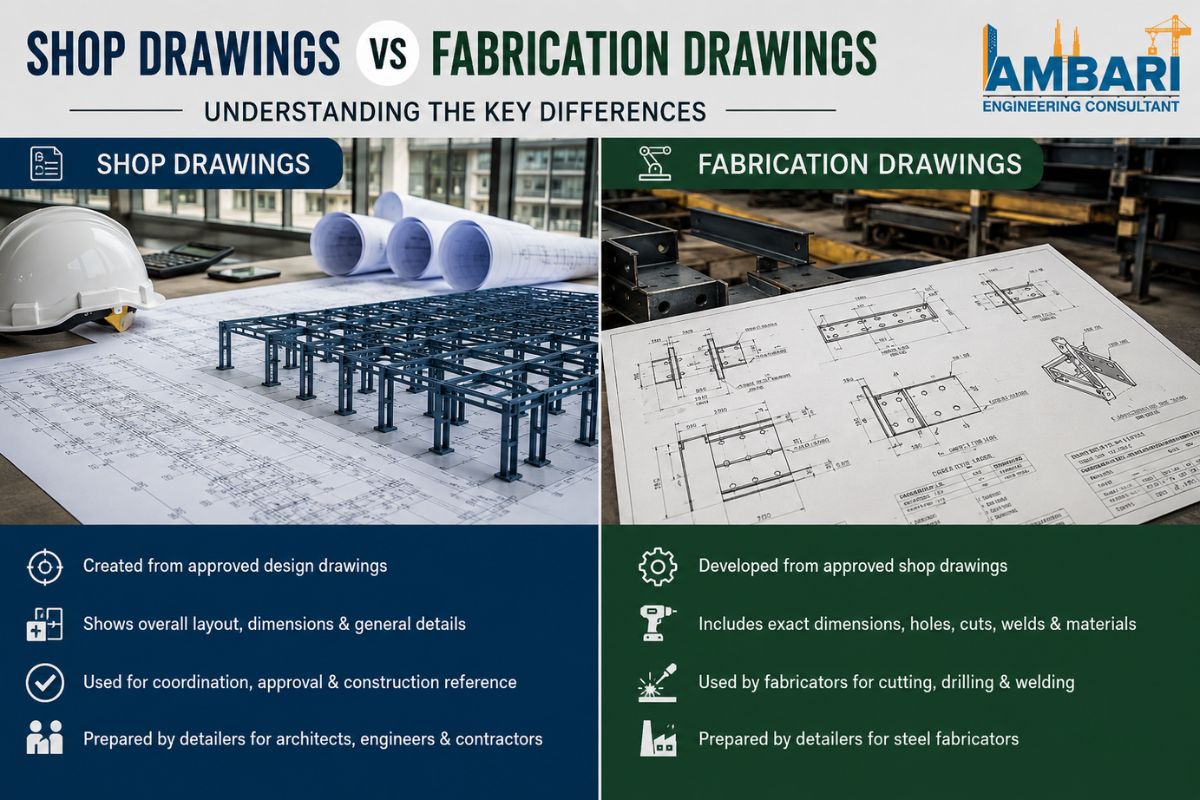
Shop drawings act as a link between the engineer's design and the final steel structure. They demonstrate the production of each piece of steel (beam, column, bracket, stairs, etc.) and how it will be used in the project. These drawings are used to ensure that all parts are manufactured and fitted properly.
A typical shop drawing includes:
- Overall dimensions and orientation
- Connection details and bolt patterns
- Material grade and finish
- References back to the structural engineering drawings
Who Uses Shop Drawings?
The fundamental function of shop drawings is that project managers, contractors, and structural engineers utilize them for approval. Therefore, before the fabrication of any part, the design team ensures that the component conforms with the original structure design. If there are design incongruities, such as problems with access, services, or dimensions, these issues are addressed by the shop drawings before any steel is in place.
What are fabrication drawings?
Fabrication drawings pick up where shop drawings leave off. Once a shop drawing has been reviewed and approved, it gets developed into a fabrication drawing, sometimes called a detail drawing, that the workshop floor actually works from.
These drawings are far more granular. They specify:
- Exact cut lengths and angles
- Weld symbols and weld sizes
- Hole diameters and bolt hole spacing
- Assembly sequence for multi-part components
- Camber, tolerances, and surface treatment notes
Why Fabricators Need This Level of Detail
A welder or CNC operator can't work from a general arrangement drawing. They need instructions precise enough that two different fabricators, working independently, would produce identical pieces. That's really what structural steel detailing services Australia providers are being paid for: removing guesswork from the workshop floor.
Shop drawings vs fabrication drawings: differences explained
| Aspect | Shop Drawings | Fabrication Drawings |
|---|---|---|
| Purpose | Review and approval of design intent | Instructions for actual manufacturing |
| Audience | Engineers, architects, contractors | Fabricators, welders, machine operators |
| Detail level | General dimensions, connections | Cut lengths, welds, tolerances, sequencing |
| Stage in process | Comes first, pre-approval | Comes after shop drawing sign-off |
| Format | Often 2D layout with annotations | Highly detailed, sometimes CNC-ready files |
The simplest way to think about it: shop drawings answer "does this design work?" Fabrication drawings answer "how exactly do we build it?" Steel fabrication drawings services in Australia can be helpful.
Why does the distinction matter on a real project?
There are certain recurring problems associated with bypassing or hastening either phase.
- Unapproved drawings lead to reworking and wasted materials: The process of fabrication may begin with unapproved drawings, and later, if the engineer requires changes, the shop may have already fashioned steels on the premises that do not correspond to the necessary values.
- Industry delay: The steel reaches the site without the necessary information regarding fabrication levels and has to be modified on site by drilling holes or trimming and rewelding structures, thus causing unnecessary costs of labor.
- Disputes between the contractor and fabricator: If the drawings are unclear, it is hard to figure out who is to blame in case of mistakes. If the drawings are specific, the act of fabrication becomes clearer since everything is indicated.
Moreover, experienced project managers treat both drawing sets as checkpoints, not paperwork to rush through. Projects that invest properly in shop fabrication drawing services in Australia at the outset tend to see fewer variations and cleaner handovers between design and construction.
Common mistakes contractors make
- Treating shop drawings as fabrication-ready: They're not detailed enough for cutting and welding, no matter how complete they look.
- Skipping the approval loop to save time: Fabricating before sign-off almost always costs more time than it saves.
- Assuming one detailer can rush both stages equally: Fabrication drawings need a different level of scrutiny. A missed weld callout is far more costly than a missed dimension label.
- Using outdated revisions: On fast-moving projects, drawing version control gets sloppy, and workshops end up building from superseded files. This gap shows up fastest on projects that never invested in proper shop fabrication drawing services in Australia to begin with.
- Not involving the fabricator early: Fabricators often catch practical issues, like access for welding equipment or transport size limits, that a purely design-focused shop drawing might miss.
How does a professional consultant approach both drawing types?
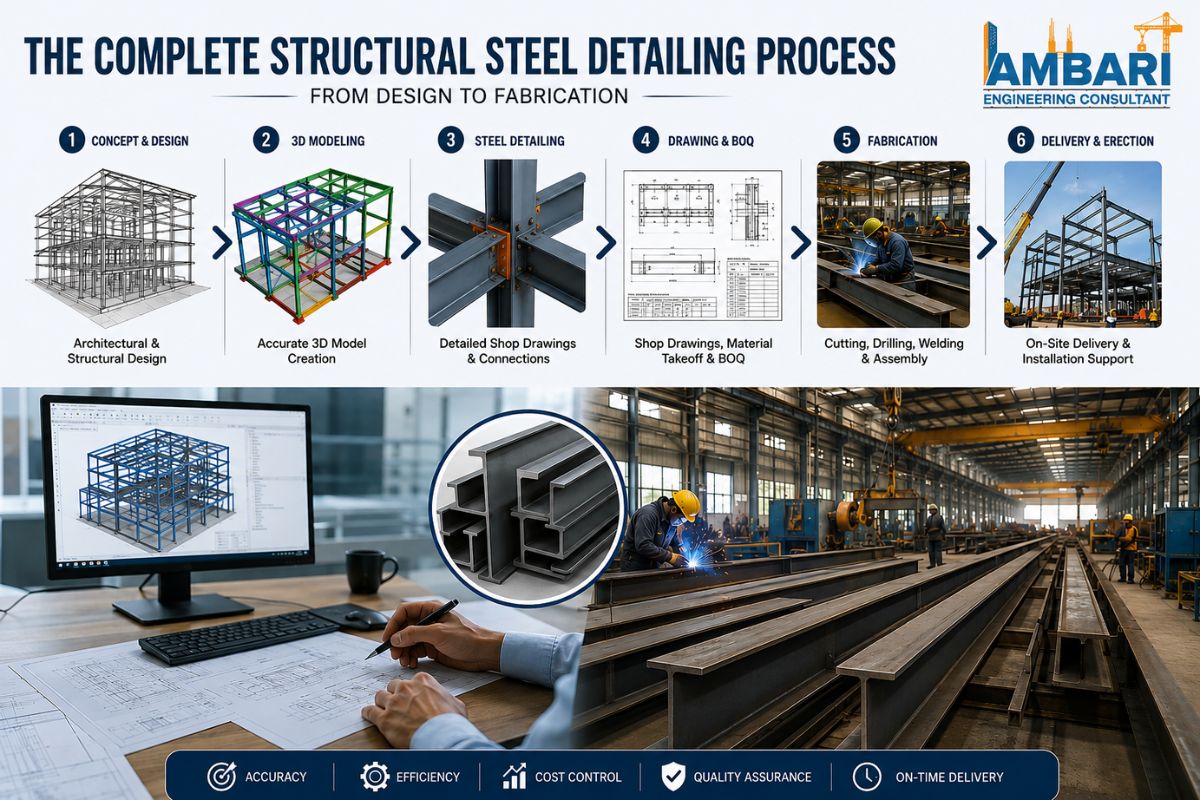
Ambari Consultant produces shop drawings and fabrication drawings as a connected process rather than two separate jobs handed to different teams. That continuity matters because it reduces the chance of information getting lost between the design-review stage and the workshop-ready stage.
For structural steel and PEB projects, the team works from the structural engineer's design through to CNC-ready fabrication output, checking connection details, bolt group capacities, and weld specifications at each step. That's what steel detailing services in Australia should look like in practice: one accountable process from design intent to finished component, instead of a series of disconnected handoffs.
Clients working across sectors, from industrial sheds to commercial fit-outs, benefit from having both drawing sets prepared with the same level of engineering rigour. It's rare for a fabrication error to trace back to just one team when the process is properly coordinated from the start.
Choosing the right detailing partner
A few practical questions help separate a reliable detailing partner from one that will cause headaches later:
- Do they understand Australian standards? AS/NZS 5131 and related codes govern structural steel fabrication in Australia, and drawings need to reflect those requirements accurately.
- Can they produce CNC-ready output? Many workshops now run automated cutting and drilling equipment, so drawings need to be compatible with that machinery.
- How do they handle revisions? Ask how change requests get tracked and communicated back to the fabricator.
- Do they have experience across project types? PEB structures, commercial buildings, and industrial sheds each carry different detailing challenges.
A provider offering genuine structural steel detailing services Australia clients can rely on should be able to walk you through their process for both drawing stages, not just show you finished samples.
Bottom line
Shop drawings and fabrication drawings aren't interchangeable paperwork. They serve two distinct purposes at two distinct stages of a steel project. Treating them as separate, deliberate checkpoints protects budgets, timelines, and the relationship between contractor and fabricator. When both stages get the same level of care, projects move from design to finished steel with far fewer surprises.
If your next project needs dependable shop drawings and fabrication drawings handled under one coordinated process, Ambari Consultant can help. Get in touch to discuss steel fabrication drawings services in Australia tailored to your project's timeline and structural requirements.
Frequently asked questions
1. What is the main difference between a shop drawing and a fabrication drawing?
A shop drawing shows design intent and general dimensions for review, while a fabrication drawing gives the exact cutting, welding, and assembly instructions the workshop needs to manufacture the piece.
2. Do fabrication drawings always come after shop drawings?
Yes, in a properly managed process. Fabrication drawings only get developed after the shop drawing has been reviewed and approved by the relevant engineer or contractor.
3. Who typically approves shop drawings?
Structural engineers, architects, or project managers usually review and sign off on shop drawings before fabrication begins.
4. Can fabrication start without shop drawing approval?
It shouldn't. Starting fabrication early risks producing steel that no longer matches the design if changes come through during review.
5. Are fabrication drawings required for small projects?
Yes. Even small steel components benefit from proper fabrication drawings, since incorrect cuts or welds still cause delays regardless of project size.
6. How do detailing errors affect project cost?
Errors caught after fabrication usually mean re-cutting material, extra labour, and schedule delays, all of which cost more than catching the issue at the drawing stage.
7. Do detailing standards differ across Australian states?
Though the basic structural codes apply throughout the nation, some municipalities and regions add extra requirements, so it pays to consider working with a detailer familiar with your project area.
8. What information should a fabrication drawing always include?
At the very least, they must show essential dimensions, indicatives of welding processes as well as bolt hole positions, material properties, and manufacturing processes for assemblies made of multiple elements.
9. How can contractors reduce rework caused by drawing errors?
By working with a single provider for shop and fabrication drawings and controlling all the revisions and changes made, contractors can significantly reduce rework on-site.