.png)

Every steel-framed building, whether it's a warehouse in Ohio or a mid-rise in Texas, goes through one step that nobody outside the industry thinks about: detailing. Structural engineers hand over drawings showing sizes, spans, and loads. Fabricators can't cut, punch, or weld anything from that alone. Somebody has to turn the engineer's intent into exact dimensions, bolt patterns, and connection details a shop floor can actually build from.
Do that well, and nobody notices. Steel shows up, fits, goes up on schedule. Do it poorly and you find out during erection, when a beam won't line up, or a connection plate is short a hole.
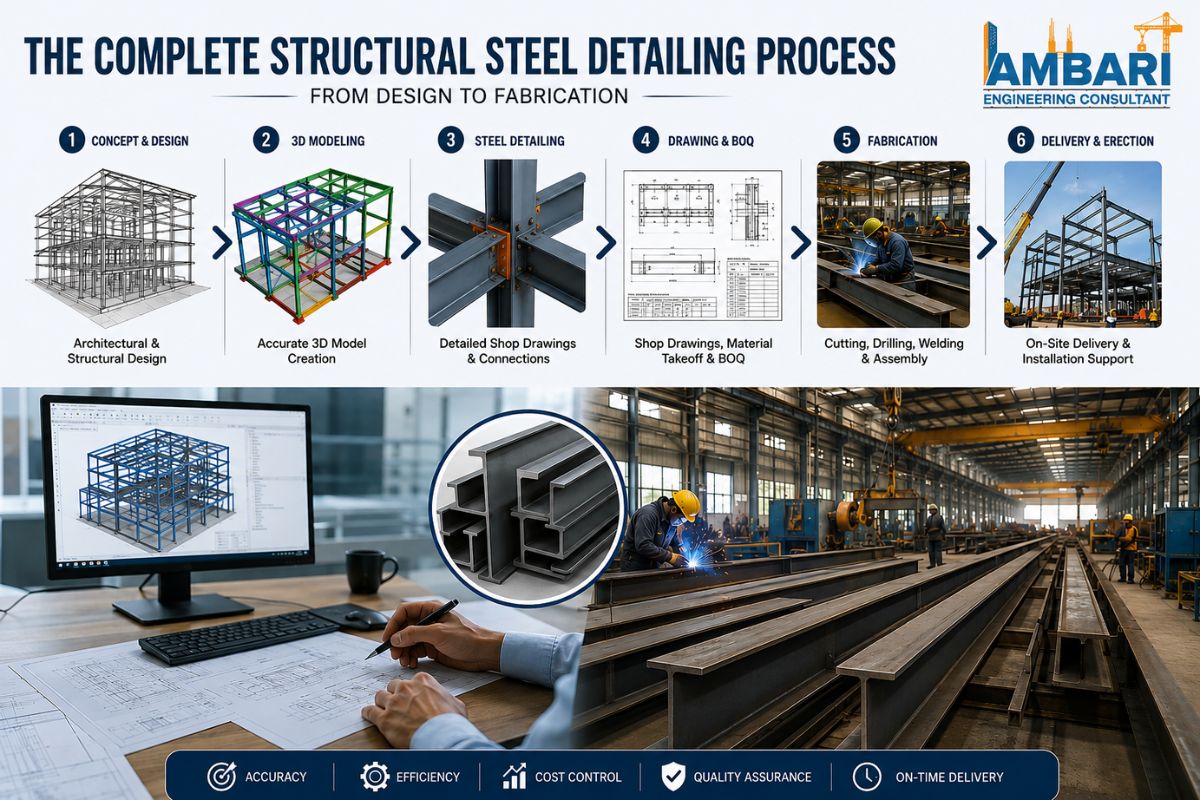
This walks through the full process behind structural steel detailing services USA, from the moment design drawings land on a detailer's desk to the point where erection crews are working off approved drawings in the field.
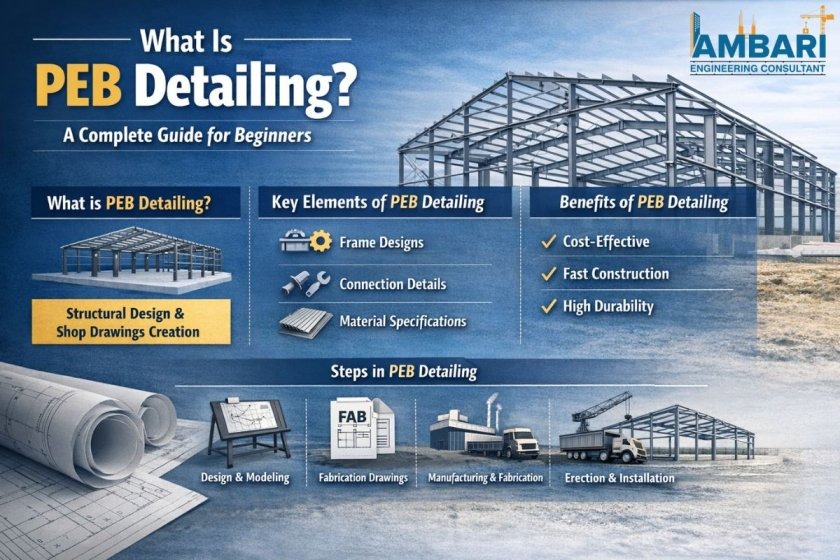
Steel detailing sits between structural engineering and fabrication. The engineer decides what the steel needs to do: carry a certain load, span a certain distance, meet code. The detailer works out exactly how that steel gets made and put together.
However, that covers member sizes down to the exact length, bolt hole locations, weld symbols, connection types, and camber requirements. It also means coordinating with other trades- mechanical, electrical, architectural- so a beam doesn't end up running through a duct opening nobody flagged.
Most detailers now work in 3D modeling software, building a digital version of the whole steel frame before a single shop drawing goes out. That model becomes the reference point for everything downstream: fabrication drawings, erection drawings, material lists.
A structural engineer's stamped drawings are usually drawn to show design intent, not fabrication precision. There's a real gap between "this beam needs to be W12x26, roughly 20 feet long" and "cut to 19'-11 3/4", with four 7/8" holes at these specific coordinates."
That gap is where detailing services in the USA earn their keep. Get it wrong, and the fallout gets expensive fast, especially once steel is already cut:
| Detailing Error | Typical Consequence |
|---|---|
| Wrong bolt hole spacing | Field drilling required, delays erection crew |
| Missed connection type | Fabricator stops, waits on RFI response |
| Incorrect member length | Steel rejected or reworked at shop |
| Clash with mechanical duct | Rework after steel is already up |
| Wrong camber value | Floor doesn't sit level, remedial work needed |
These aren't hypothetical. They're what actually happens when detailing gets rushed, or handed to someone without enough field experience to know what a shop needs.
Before any modeling starts, the detailing team goes through the structural engineer's design drawings, general notes, and project specs. People underestimate this step. It sets the tone for everything after it.
A good detailer reads more than the drawings themselves. They check:
Furthermore, this is also where detailers flag anything unclear or contradictory. Resolving a discrepancy now costs far less than resolving it after fabrication drawings are already out.
Once the documents make sense, the detailer builds a full 3D model of the steel structure. Every member, connection, and piece of hardware gets modeled to exact dimensions.
This is where structural steel detailing services USA break from the older, 2D drafting approach. A 3D model catches clashes- a beam intersecting a column flange, a brace running into a duct- before steel is ever cut. It also generates accurate quantities for material takeoffs, which procurement teams rely on for ordering.
Experienced detailers build the model in the order steel will actually go up, not whatever order is convenient on screen. That habit alone heads off a lot of erection-sequence problems down the line.
Once the model checks out, it generates shop fabrication drawings, the documents a fabrication shop actually builds from. These go into far more detail than architectural or structural drawings. Each piece mark gets its own drawing showing:
Shop fabrication drawing services in USA can produce hundreds, sometimes thousands, of individual piece drawings on a mid-size commercial project. Every one of them has to line up with the 3D model and with every other drawing touching the same connection.
Mistakes here don't stay contained. If a beam's hole pattern is off by even a quarter inch, that error travels straight to the shop floor and from there to the job site.
Connections are where the real engineering judgment shows up. A beam is a beam. But how it attaches to a column, and whether that connection can actually carry the required shear and moment, takes real technical understanding.
Steel Connection Detailing Services in USA generally split into two categories:
Either way, this step needs close coordination between the detailer and the engineer of record. Rushed connection detailing is probably the single biggest source of RFIs on steel projects. A detailer guesses at intent instead of confirming it, and the guess is wrong.
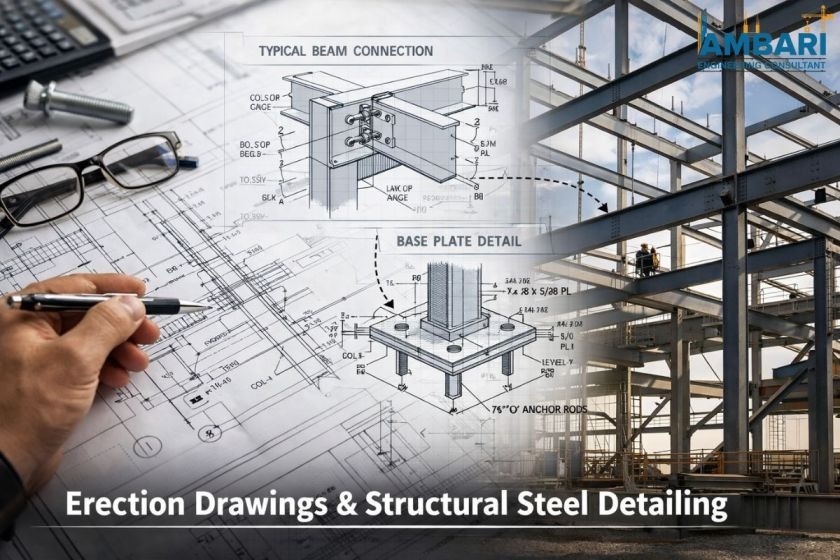
Shop drawings tell the fabricator how to build each piece. Erection drawings tell the field crew how those pieces go together, in what order, and where each piece mark lands on the structure.
These drawings cover:
Therefore, a detailing team with real field experience sequences these drawings the way steel actually goes up, not just logically on paper, but in a way that accounts for crane reach, temporary shoring, and site access. This is where experience shows. Someone who has only worked in an office, and never watched steel go up, tends to miss the practical constraints that make an erection sequence actually work.
No detailing package goes from first draft to approved without at least one review cycle, usually more. The engineer of record checks shop and erection drawings against the design intent, marks up whatever needs fixing, and sends them back.
This back-and-forth is normal, and honestly useful. It catches things one set of eyes misses. What separates a solid detailing partner from an average one is how they handle this stage:
Projects that fall behind schedule often trace the delay back to slow RFI turnaround here, not to fabrication itself.
A few patterns keep showing up on projects where detailing wasn't handled carefully:
Most of this comes down to one thing: treating detailing as a drafting task instead of a technical discipline that needs engineering judgment and field awareness.
Not every provider offering steel detailing services in the USA operates at the same level. Worth checking before committing to a detailing partner:
A detailing team that asks good questions early, about connection responsibility, coating requirements, and erection sequencing, is usually a better sign than one that just starts modeling right away.
Ambari Consultant works through each of these steps methodically, from initial drawing review through erection drawing sign-off, paying attention to the connection detailing and coordination work that tends to get rushed elsewhere.
Detailing hardly ever gets proper acknowledgment and appreciation, but it plays an important role in a successful steel project. In case you are contemplating the construction of a project with a steel frame and require detailing services, choose Ambari Consultant, and we will examine your drawings and design in detail before the fabrication time starts.
.jpeg)