.png)

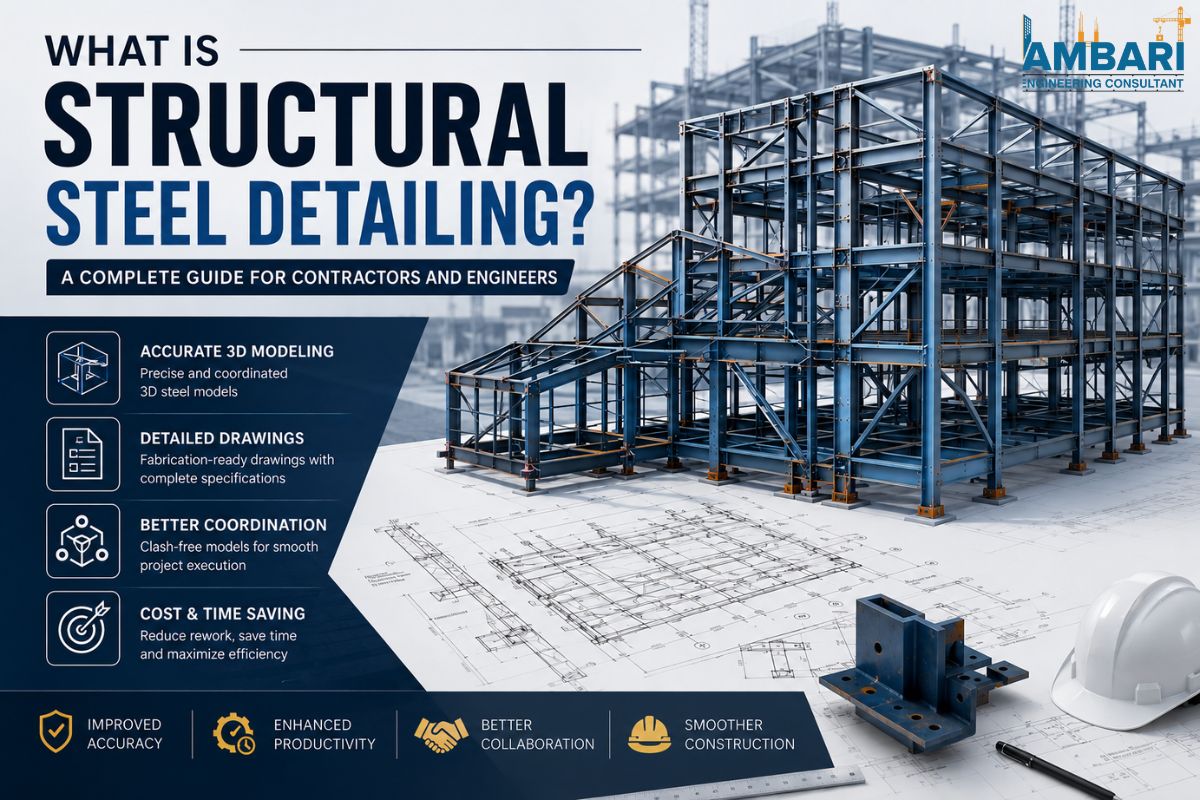
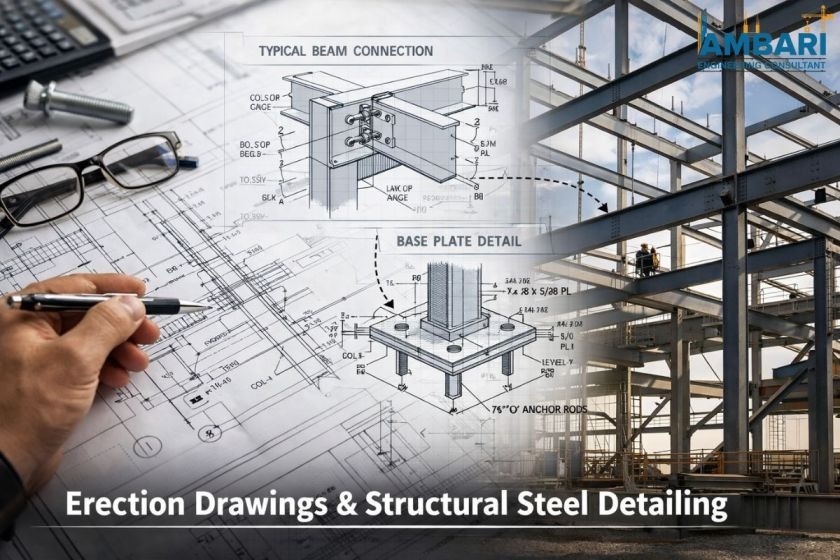
Structural steel detailing is the process of converting engineering designs into detailed drawings that guide fabrication and erection. A structural steel detailer studies structural plans, then creates shop drawings, erection drawings, and connection details so fabricators know the exact size, shape, and placement of every steel piece.
However, this role sits between the engineer's design and the fabricator's workshop, and it's where a lot of the real problem-solving happens. Skip this step, or rush it, and projects run into delays, wasted material, and costly fixes on site.
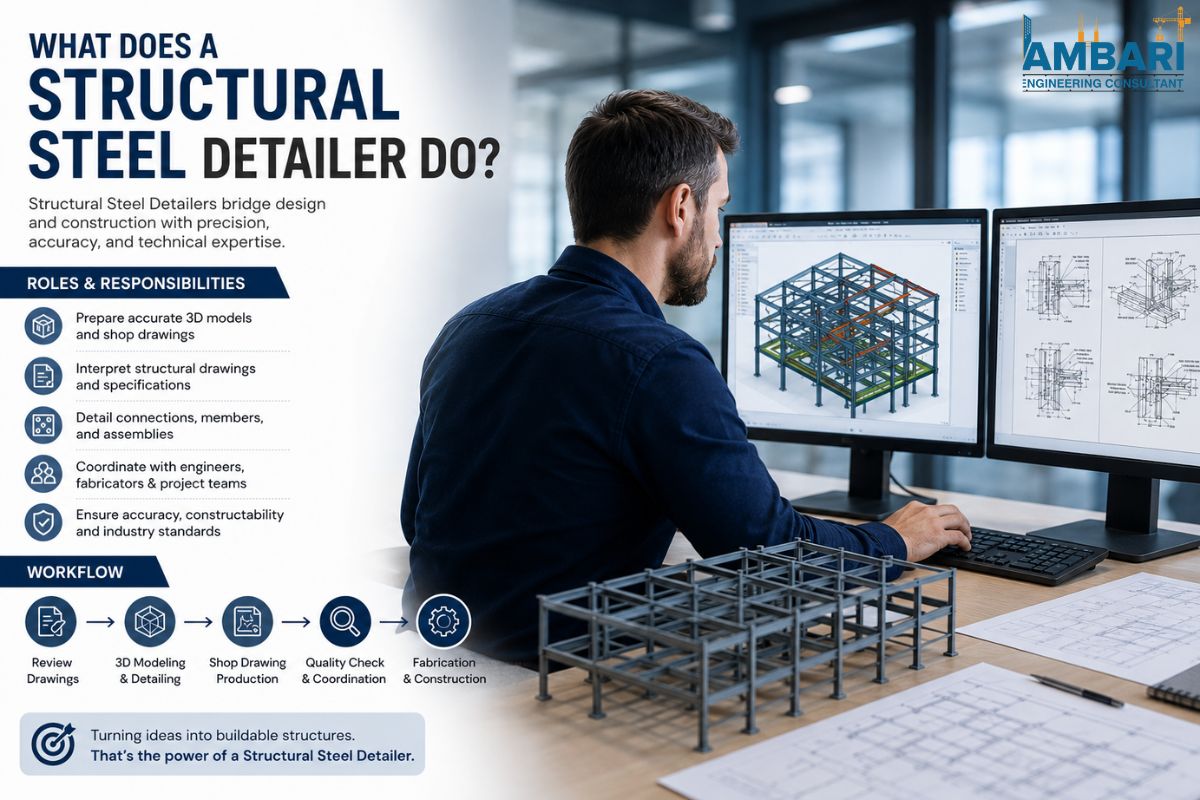
A structural steel detailer reads structural engineering drawings and turns them into building-ready documents. In practice, they sit between the design team and the people cutting, welding, and lifting steel on site.
They don't design the structure. That's the engineer's job. What detailers do is work out how that design actually gets built: bolt sizes, connection types, plate thicknesses, and how each beam or column fits with the next piece. For the fabricator, the drawing has to answer one question without any doubt left in it. “What do I make, and how does it go together?”
Most detailers come up through drafting, civil engineering, or mechanical design backgrounds. Over the years, they pick up a working knowledge of steel codes, fabrication limits, and how a job actually gets sequenced on site. That last part matters more than people expect. A detailer who has spent time around a real fabrication shop or watched steel go up on-site tends to produce drawings that hold up better under pressure than one who has only ever worked from a screen.
A steel detailer's daily work covers a lot of ground, but it all comes back to one thing: giving fabricators and erectors drawings they can trust without guesswork.
Here's what that usually includes:
Furthermore, detailers also spend a good chunk of their time talking to engineers, project managers, and fabrication shops. Drawings rarely sail through on the first pass. A few rounds of questions and corrections is normal, not a sign that something's gone wrong.
Steel detailing is rarely a one-person job once a project has any real size to it. Larger jobs run through a team, and each person on that team owns a different piece of the puzzle.
Junior Detailer – Handles basic shop drawings, piece marks, and simple layouts under supervision. This is usually where someone starts out in the field.
Senior or Lead Detailer – Takes on the harder sections of the model, reviews junior work, and signs off before drawings go out to the client or fabricator
Connection Detailer – Works only on bolted and welded joints, figuring out load paths and hardware for the trickier connections between members
BIM Coordinator – Owns the 3D model itself, runs clash checks against architectural and MEP drawings, and keeps every discipline working off the same version.
Checker or QA Detailer - Goes back through finished drawings against the engineer's design before release, catching whatever slipped through earlier
Project Coordinator – Sits between the detailing team, the structural engineer, and the fabrication shop, keeping revisions and deadlines from slipping
On a smaller job, one person might cover three or four of these roles at once. On bigger commercial or industrial projects, each one becomes its own full-time job, and the team works together to keep drawings accurate and moving on schedule.
Detailing today runs on 3D modeling, not flat 2D drawings alone. That change is a big part of why the process has gotten faster and more accurate.
Detailers build a full digital model of the steel structure using specialized 3D detailing software, then pull shop drawings, erection plans, and material lists straight out of that model. Because everything comes from one connected model, a change in one place updates everywhere else automatically. Fewer missed revisions, fewer arguments over which version is current.
Alongside the 3D modeling, most detailers still use 2D drafting programs for certain layouts, dedicated connection design software for the harder joints, and coordination software to catch clashes between steel and other trades like plumbing or HVAC. Firms offering steel detailing services in Australia generally lean on this mix of modeling and coordination tools to keep drawings aligned with local codes and actual site conditions, not just the design on paper.
For any company juggling several projects at once, this software isn't a nice-to-have. It's the only realistic way to keep track of hundreds of steel pieces without losing a single bolt hole somewhere along the way.
Every detailing project moves through roughly the same sequence, even if the specifics shift from job to job.
| Stage | What Happens | Output |
|---|---|---|
| Design Review | Detailer studies structural engineering drawings and specifications | Understanding of loads, member sizes, and codes |
| 3D Modeling | Steel structure is modeled using 3D detailing software | Complete digital model of the frame |
| Connection Detailing | Bolted and welded connections are worked out for each joint | Connection drawings and details |
| Clash Detection | Model is checked against architectural and MEP drawings | List of conflicts to resolve before fabrication |
| Shop Drawings | Individual piece drawings are generated from the model | Fabrication-ready drawings for the workshop |
| Erection Drawings | Site assembly sequence and piece locations are documented | Drawings that guide the on-site crew |
| Review & Approval | Engineer and client review drawings for accuracy | Approved, stamped drawings ready for fabrication |
Ambari Consultant follows this same sequence on every project, whether it's a small warehouse extension or a full industrial facility. Rushing the clash detection stage, in particular, is one of the more common reasons a project ends up with expensive problems on site later.
One mistake in a shop drawing can work its way through an entire project. Wrong bolt sizes mean holes that don't line up on site. A missed connection detail can hold up a whole crew waiting on a fix. None of this is minor. It costs real money and real time on every project it touches.
Good detailing catches these problems on screen instead of on site. A clash check that finds a beam running into a duct is a five-minute fix in the model. Found on site instead, that same conflict turns into a delay measured in days, not minutes.
However, this is part of why steel fabrication drawings services in Australia get treated as their own specialty rather than a generic drafting task. Fabricators build directly from these drawings, so there's no room for anything unclear. A shop cutting hundreds of steel members off one set of drawings can't afford one vague dimension, because that mistake doesn't stay small. It multiplies across the whole batch.
Accurate detailing also backs up compliance. Structures have to meet local building codes and safety standards, and the detailed drawings are part of what proves a project was actually built the way it was supposed to be.
Detailing teams don't all work the same way, and that difference tends to show up in how a project actually turns out. A few things are worth checking before picking a partner for structural steel work.
Look for a team that's worked across different project types, not just one industry. A detailer who has handled warehouses, commercial buildings, and industrial plants has seen a wider range of connection types and fabrication problems, and that experience shows up in the drawings.
Software capability is worth checking too. Teams working with modern 3D modeling and coordination tools tend to catch errors earlier and turn revisions around faster than teams still stuck on older 2D-only methods. This matters even more for Steel Connection Detailing Services in Australia, where getting the connection right directly affects how safely and how quickly a structure goes up on site.
Turnaround time and communication matter just as much. Steel projects run on tight schedules, and a team that answers questions quickly keeps the whole job moving instead of stalling out. Ambari Consultant works with fabricators and contractors across Australia, offering structural steel detailing services. Australia is built around accuracy, clear communication, and delivery timelines that hold up.
| Factor | In-House Team | Outsourced Detailing Team |
|---|---|---|
| Setup Cost | High, needs software and trained staff | Low, pay per project or on retainer |
| Flexibility | Limited during busy or slow periods | Scales up or down based on project load |
| Software Access | Requires ongoing license investment | Already equipped with modeling and coordination tools |
| Turnaround Speed | Depends on team size and workload | Often faster with dedicated detailing staff |
| Specialization | May lack experience across varied project types | Exposure to diverse projects and connection types |
A lot of contractors end up outsourcing detailing work simply because it gives them access to specialized skills without carrying a full in-house team year-round, which matters most for projects that come in waves rather than a steady, predictable flow.
A structural steel detailer plays an important role in every steel construction project. They create correct shop drawings, connections, and fabrication drawings to minimize mistakes and time delays.
For commercial, industrial, or infrastructure projects, you can trust Ambari Consultant for accurate structural steel detailing services Australia that deliver on time. Call us today to talk about your project and receive a quote to fit your fabrication timeline.
1. What does a structural steel detailer actually do?
Structural steel detailers take the engineering drawings and create shop and erection drawings that instruct the fabricators on how to cut, weld, and assemble each piece of steel.
2. Is a steel detailer the same as a structural engineer?
No, engineers make the design and work out loads, and detailers make the drawing for the people who make the structure in reality.
3. What are the different roles within a detailing team?
Different people within a team are involved in different aspects of a detailing process, such as junior detailers, senior detailers, connection specialists, BIM coordinators, and checkers.
4. Why do fabricators need detailed shop drawings?
Shop drawings provide the fabricators with precise dimensions, bolt patterns, and connection information; there's no guesswork, and less expensive errors are made when fabricating the steel.
5. How long does structural steel detailing take?
The timeline is based on the size and scope of the project. Most detailing teams offer estimates only following the review of the structural drawings and detailed project scope.
6. Can detailing services help avoid on-site delays?
Yes. Because of the clash detection that occurs during modeling, problems are identified before fabrication begins, saving delays when they are found on site.
7. What industries use structural steel detailing services?
For commercial buildings, warehouses, industrial plants, and infrastructure projects, the detailing services are critical to ensuring accurate and on-time fabrication and erection.
8. How do I choose a reliable steel detailing company?
Look at their software skills, experience in various industries, speed, and clarity about their revisions and clash detection process.