.png)

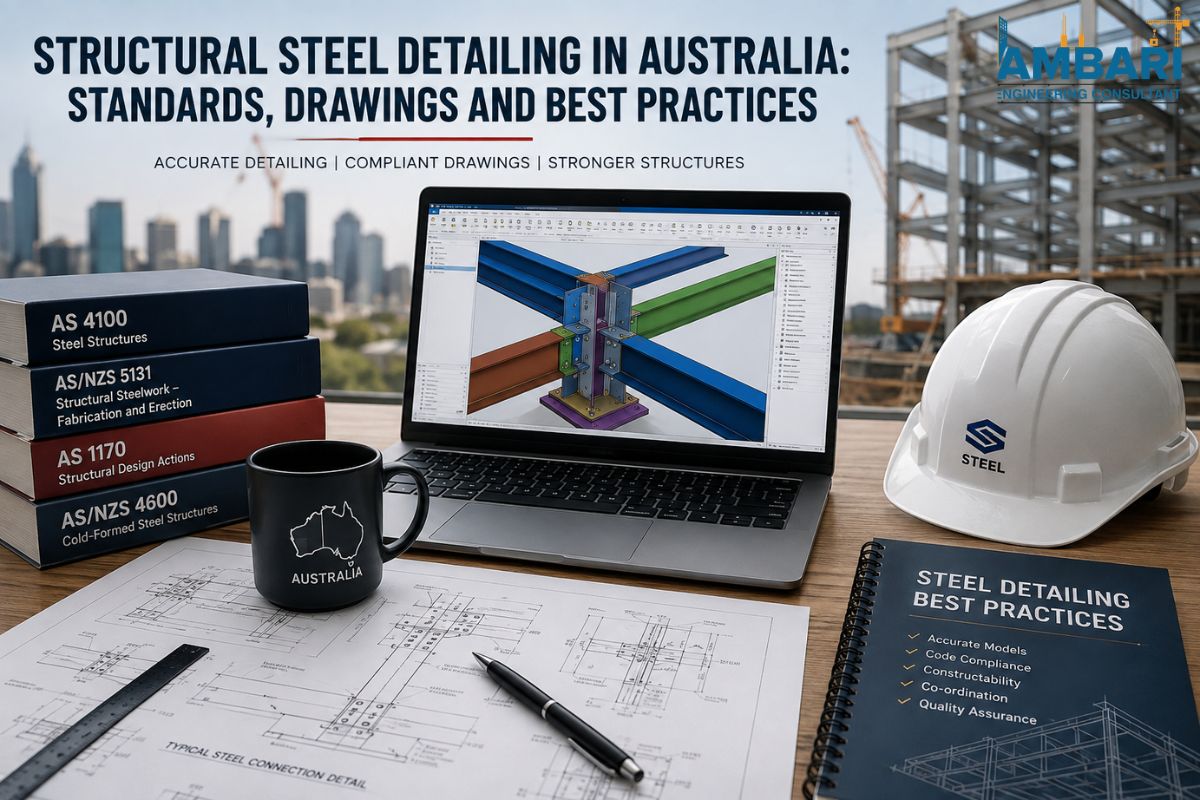
Companies that provide structural steel detailing services in Australia convert engineering plans into drawings that can be fabricated and implemented according to A.S. 4100 and A.S./N.S.Z 5131 standards. The detailers are required to make shop drawings used in cutting, welding, and bolting, as well as erection drawings that help crews understand sequential tasks to be accomplished on site locations.
The Australian structural steel fabrication industry is expected to be worth about $8.6 billion by the year 2026, while the country's construction sector used almost 1.6 million tons of prefabricated structural steel in 2023. Getting detailing right at this stage is the best way to avoid incurring costs of rework at the stage of fabrication.
Key takeaways
- AS 4100 is the primary standard in Australia for compliance with structural steel design requirements.
- There are distinctions between fabrication and erection drawings relevant to project stakeholders.
- With the size of the steel industry in Australia, good detailing becomes a strong competitive advantage.
- Accurate measurement and clash detection help in minimizing the amount of rework necessary during fabrication and construction.
Why does steel detailing decide project outcomes?
Every structural steel endeavor proceeds with two sets of instructions: what was planned by the engineer and what can be fabricated by the fabricator. With detailing, the two parties can cooperate efficiently. Ignoring detailing means ending up with beams that do not match on site, holes that are misplaced by a couple of millimeters, or connection details that cannot be practically performed.
As a consequence, Australian firms specializing in structural steel detailing services are getting increasingly busy along with the construction business in Australia. There are now nearly two thousand structural steel fabricating companies in the country. Each firm is concerned about the importance of the detailing process in the entire fabrication. If there is a one-dimensional error made, the project may get behind schedule.
Moreover, detailing can have some legal implications. Any submitted drawing needs to comply with Australian Standards, or else the certifier will halt the certification process until everything is changed.
Standards behind steel detailing services
Anyone offering steel detailing services in Australia has to work within a specific standards framework, and it's tighter than people expect coming from other markets.
AS 4100, Steel Structures, is the design standard. It's referenced in the National Construction Code and Building Code of Australia for structural steelwork in Class 1 to 10 buildings. It sets minimum yield strength criteria for structural steel, typically ranging from 250 MPa to 500 MPa, and governs how members and connections are sized against dead loads, live loads, wind and seismic forces.
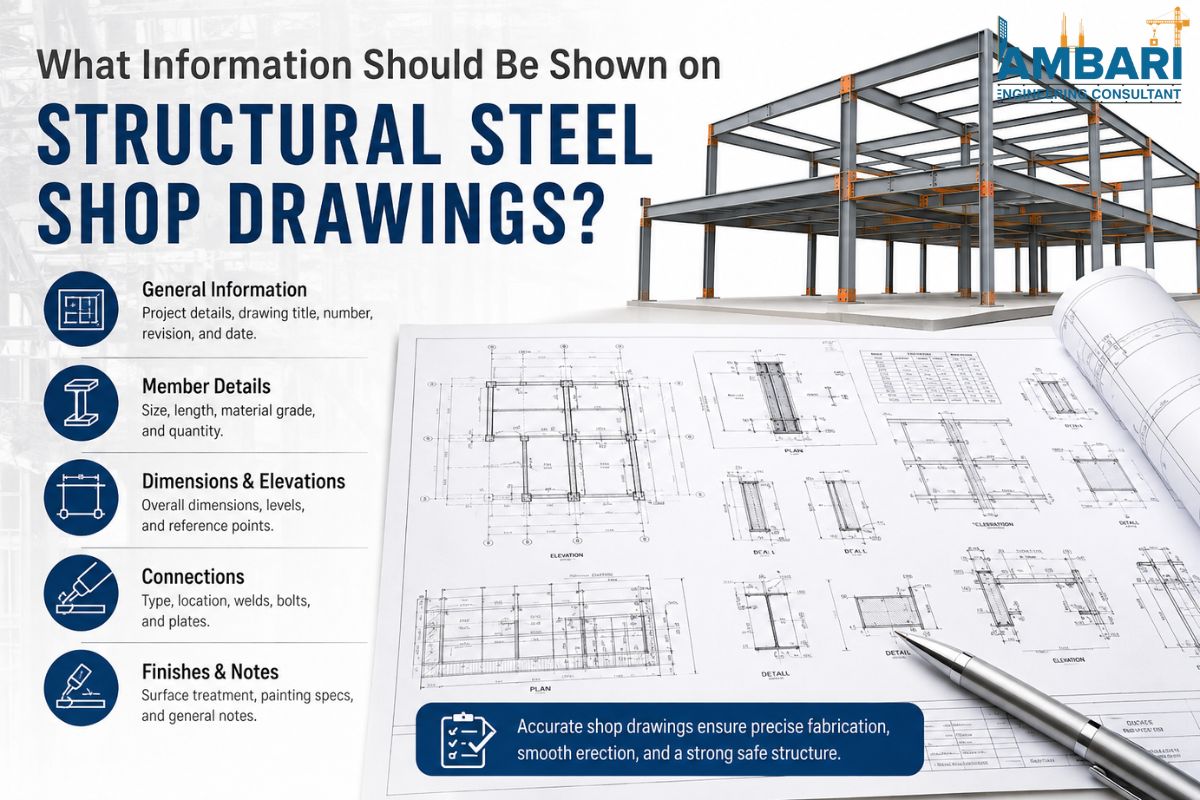
AS/NZS 5131, Fabrication and Erection, picks up where design ends. It's called up by the primary referenced standards and becomes a secondary referenced standard under the NCC, or gets required directly through the construction specification. It sets construction categories, CC1 through CC4, that determine how much documentation, weld testing, and inspection a project needs. This is a detail a lot of smaller fabricators still get wrong.
AS/NZS 1554 covers welding. Detailers need to specify weld types and sizes that match what this standard permits for the steel grade and loading condition involved, not just what looks structurally sound on a 3D model.
Worth knowing before you start:
- The NCC doesn't accept an equivalent overseas standard in place of AS 4100. Imported designs still need to be checked against it.
- Tier-1 projects generally require compliance with the National Structural Steelwork Compliance Scheme, sitting on top of the design standards.
- Construction category under AS/NZS 5131 should be settled before detailing starts, not retrofitted once drawings are underway.
What steel fabrication drawings services actually deliver?
Fabrication drawings are shop-floor documents. They're not meant for an architect or a site foreman. They're meant for the person running the plasma cutter or setting up the welding jig.
A proper set of steel fabrication drawings services in Australia typically includes:
- Piece marks - for every individual member, so nothing gets mixed up between the shop and the yard
- Cutting lists - with exact lengths, angles and hole positions
- Connection details - flexible end plates, moment end plates, base plates, splice and gusset plates, all drawn to the tolerances AS 4100 allows
- Bolt schedules - specifying grade, diameter and torque requirements
- Weld symbols - matched to AS/NZS 1554 categories
- Material specifications - tied back to the steel grade called up in the engineer's design
Moreover, the part that goes wrong most often isn't the geometry. It's the coordination between drawings and the actual steel available. A detailer who specs a section size that's on back order, or misses a fabricator's standard tolerance for a particular joint, hands the shop a drawing that looks correct and still causes delays.
Structural erection drawings and site sequencing
Fabrication drawings tell the shop what to build. Structural erection drawings services in Australia produce the second document set, the one that tells the site crew what order to put it up in and where each piece goes once it arrives on a truck.
Erection drawings usually cover:
- General arrangement plans showing every member's position relative to grid lines and levels
- Anchor bolt setting-out plans for foundations, issued early enough for the concrete crew to work from
- Erection sequence diagrams, particularly important on multi-storey or tight-access sites where crane reach dictates the order pieces go up
- Temporary bracing requirements. Steel is often unstable until enough of the frame is connected, and this needs documenting, not left to the crew's judgement
- As-built markups once erection is complete, feeding into regulatory close-out documentation
Therefore, a mistake that keeps showing up across projects is treating erection drawings as an afterthought once fabrication drawings are signed off. On sites with restricted crane access or staged handover, the erection sequence can actually shape how members get piece-marked and grouped for delivery. Planning both together saves a second round of coordination later.
In-house vs outsourced detailing: A comparison
| Factor | In-House Detailing Team | Outsourced Detailing Services |
|---|---|---|
| Upfront cost | High: software licences, hiring, training | Lower, pay per project or drawing set |
| Scalability during peak load | Limited by team headcount | Can flex up across multiple concurrent projects |
| Standards familiarity | Depends on team's project history | Firms working across states typically see a wider range of AS 4100/AS 5131 scenarios |
| Turnaround on revisions | Fast, but bottlenecked by staff availability | Depends on provider's queue and communication clarity |
| Best suited for | Large fabricators with steady, predictable volume | Contractors, PEB manufacturers and fabricators with variable project pipelines |
Neither option is universally better. A fabricator running consistent volume year-round often justifies an in-house team. A contractor bidding on irregular projects—a warehouse this quarter, a mezzanine structure the next—usually gets more value from outsourced structural steel detailing services Australia firms that can scale with the workload.
Mistakes that cost projects time and money
A few patterns show up again and again on projects that run into trouble at fabrication or erection stage.
- Skipping clash detection - Steel, services, and architectural elements often get designed in parallel. Without checking beams against ductwork, sprinkler lines and other trades' penetrations, clashes surface on site, which is the most expensive place to find them.
- Ignoring tolerance stack-up - Individual members might each sit within AS 4100's allowable tolerance, but if several small deviations compound across a long run of steel, the final connection point can end up out by a margin that no longer works.
- Under-specifying connections for the actual load case - A standard connection detail copied across a project without checking it against the specific member's design loads is a common source of certifier queries and rework.
- Late erection sequencing - Deciding sequence after fabrication is complete instead of during detailing removes options that could have simplified the crane plan or piece-marking.
- Treating drawings as static - Site conditions change. A footing gets moved, a beam gets substituted. Drawings that aren't version-controlled and reissued properly create confusion about which set the shop or the site crew is actually working from.
Choosing a detailing partner for Australian projects
Before committing to a detailing provider, it helps to ask:
- Can they show experience across the specific project type, PEB, structural steel frames, mezzanines, industrial sheds, rather than general claims of steel experience?
- Do they understand construction category requirements under AS/NZS 5131, and can they explain which category your project falls into and why?
- What's their process for revisions once fabrication has started? Quick turnaround, or does it queue behind other clients' work?
- Do they coordinate fabrication and erection drawings as a linked set, or produce them separately with limited cross-checking?
Firms like Ambari Consultant, working across pre-engineered building and structural steel detailing projects, tend to build this coordination into their process from the first drawing rather than reconciling it at the end. That upfront discipline is usually what separates a smooth fabrication run from one full of RFIs.
Bottom line
Structural steel detailing is where most of the practical risk on a steel project either gets resolved or gets passed downstream, not a drafting formality tucked between design and fabrication. With Australia's structural steel sector moving roughly 1.6 million tonnes of fabricated steel through construction each year, the margin for detailing errors keeps getting thinner as project timelines tighten.
A provider that understands AS 4100 and AS/NZS 5131 in practice, not just in theory, is what keeps fabrication drawings, erection drawings and site schedules aligned. Ambari Consultant's detailing work is built around exactly that kind of coordination, worth a conversation if your next project needs drawings that hold up from shop to site.
Frequently asked questions
1. What's the difference between fabrication drawings and erection drawings?
Fabrication drawings guide the shop on cutting, welding, and bolting individual members. Erection drawings guide the site crew on positioning and sequencing those members during installation.
2. Which Australian standard governs structural steel design?
AS 4100 is the primary design standard, referenced directly in the National Construction Code. No overseas or alternative standard is accepted as a substitute for structural steelwork design.
3. Do all steel projects need AS/NZS 5131 compliance?
Most do, either as a primary requirement or because it's called up through AS 4100 or the project's construction specification. The applicable construction category varies by project risk.
4. How long does a typical detailing project take?
It depends on project complexity, but a mid-sized industrial shed might take one to three weeks for a full fabrication and erection drawing set, longer for multi-storey structures.
5. Can detailing errors be fixed after fabrication starts?
Yes, but it's expensive. Errors caught before cutting cost far less to correct than reworking steel that's already been fabricated to the wrong dimensions or connection details.
6. Is 3D modelling necessary for steel detailing?
It significantly reduces clash risk on complex projects, though smaller, straightforward structures can sometimes be detailed reliably without it, depending on the fabricator's process.
7. What information does a detailer need from the structural engineer?
Approved structural drawings, design loads, steel grades, connection design intent, and any project-specific specifications tied to the applicable Australian Standards and construction category.
8. Why do erection drawings need anchor bolt setting-out plans?
Foundations are usually poured before steel arrives. Setting-out plans let the concrete crew place anchor bolts accurately, avoiding misalignment when steel members are erected later.
9. How is the right construction category determined under AS/NZS 5131?
It's based on factors like consequence of failure, structural complexity and service conditions, typically assessed by the structural engineer and documented before detailing begins.
10. What should I check before hiring a detailing provider?
Ask for examples of similar project types, confirmation they understand AS 4100 and AS/NZS 5131 requirements, and clarity on how they handle revisions once fabrication is underway.