.png)

If you're planning a warehouse, factory shed, or commercial building for a client, one question keeps coming up: which codes are actually being followed? PEB structures look simple on the surface. Underneath, there's a full rulebook deciding safety, load capacity, and how long the thing actually stands.
Therefore, this blog walks through the standards behind PEB Design and Detailing Services in India, so you're not just trusting a drawing to look right.
Pre-engineered buildings go up fast and cost less than conventional steel structures. That speed only holds up if the code compliance behind it is solid. One miscalculated load, one skipped tolerance, and the risk shows up years later, usually after the building's already in use.
However, professional PEB Detailing Services work from established codes for a simple reason- it's cheaper to catch an error on paper than to fix it after steel has already reached the site. India's climate and soil shift a lot between regions, and codes are how detailers actually account for that instead of guessing.
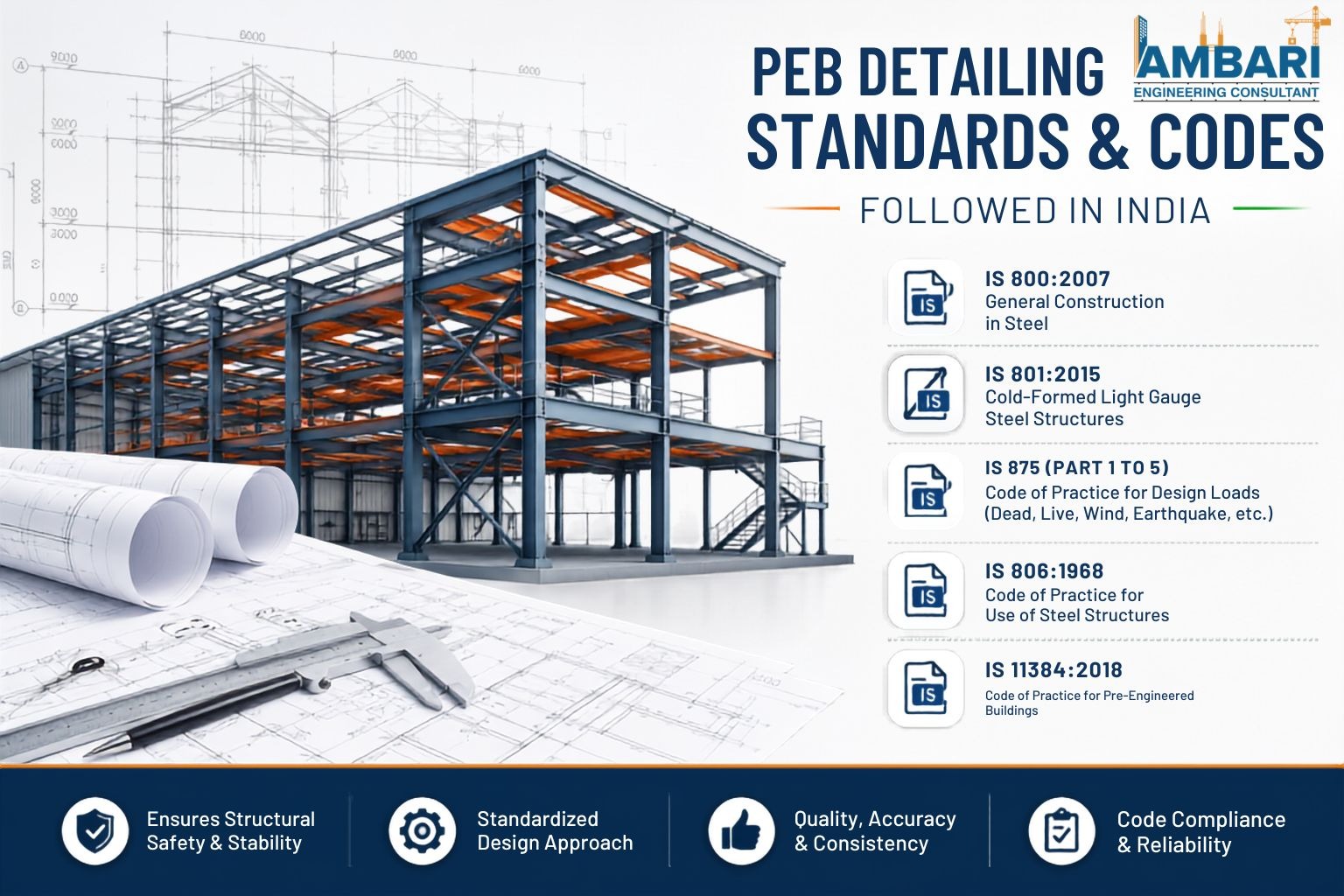
India's structural steel industry runs on Bureau of Indian Standards (BIS) codes. The ones that come up constantly:
| Code | Purpose |
|---|---|
| IS 800:2007 | General construction in steel- design philosophy |
| IS 875 (Parts 1–5) | Design loads-dead, live, wind, snow, and seismic |
| IS 1893 | Earthquake-resistant design of structures |
| IS 802 | Steel towers and masts |
| IS 4923 | Hollow steel sections used in structural work |
| IS 6533 | Design and construction of steel chimneys |
Furthermore, any solid provider of structural steel detailing services in India checks drawings against these before fabrication starts. Skip that step, and the corrections happen on-site instead, where they cost more and take longer.
India isn't one climate zone. A shed in coastal Chennai deals with wind loads that a site in seismically prone Uttarakhand never sees, and vice versa with ground shaking.
What detailers actually calculate:
A pre engineered building design India partner worth hiring runs these numbers for your specific site. Generic assumptions save time upfront and cost more later.
A lot of PEB clients in India also deal with global manufacturers or export-linked builds, so international codes often sit on top of IS standards:
Mixing IS codes with AISC or MBMA isn't rare anymore. Larger industrial jobs and export-facing projects use both routinely.
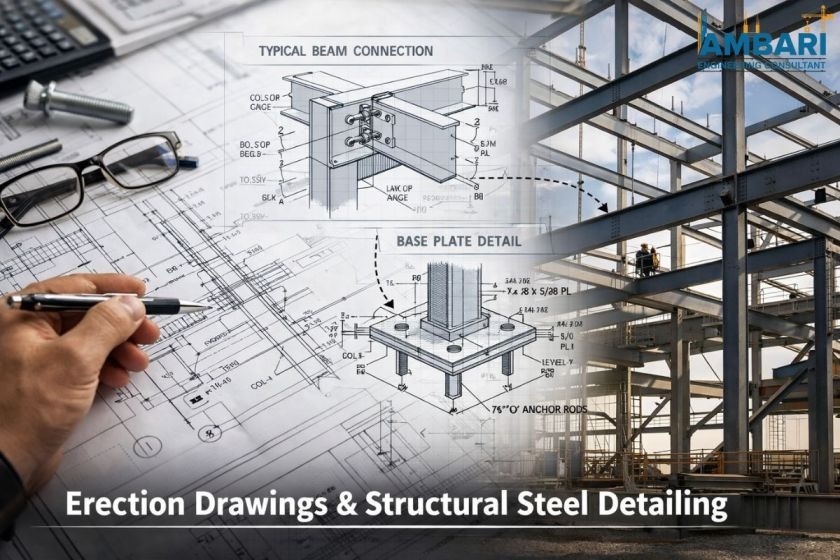
Codes don't stop at design. They cover how precisely steel gets cut, welded, and assembled, and small deviations add up fast across a large structure.
Where tolerance codes matter most:
Teams typically follow IS 800 alongside the AISC Code of Standard Practice here. The goal is simple—what fits together on a screen should fit together on-site without grinding or forcing anything.
Some firms cut corners on load calculations to move faster, and that's exactly where problems show up later, sometimes years after the building's already occupied.
Before hiring anyone, check whether they:
Moreover, Ambari Consultant builds its detailing process around exactly this: IS compliance first, international standards layered in when the project calls for it. If you're looking for PEB design and detailing services in India that hold up past the drawing stage, that's the kind of partner worth working with.
Getting PEB construction right in India comes down to the codes behind the design, not just the speed or cost savings on the surface. IS 800, IS 875, AISC, and MBMA—each one exists to keep the building standing through whatever the region throws at it, be it wind, seismic activity, or just decades of ordinary load.
If you've got an industrial shed, warehouse, or commercial PEB project coming up, don't treat code compliance as a formality. Talk to the Ambari consultant about getting detailing that's accurate on paper and solid on-site.